On This Page
A loan denial, a lost job offer, or a rejected rental application can hit hard. It’s even worse when you have no idea why it happened.
An adverse action notice is often your first real clue. Federal law requires many lenders, employers, landlords, and insurers to send one when a consumer report plays a part in a decision that goes against you.
That notice tells you where the information came from and how to check it.
At Fair Credit Attorneys, we take on credit bureaus, background check companies, and businesses that break the Fair Credit Reporting Act. If an adverse action notice has you wondering whether a report error cost you something important, call us at (866) 381-6444 or request a free case review today.
What Is an Adverse Action Notice?
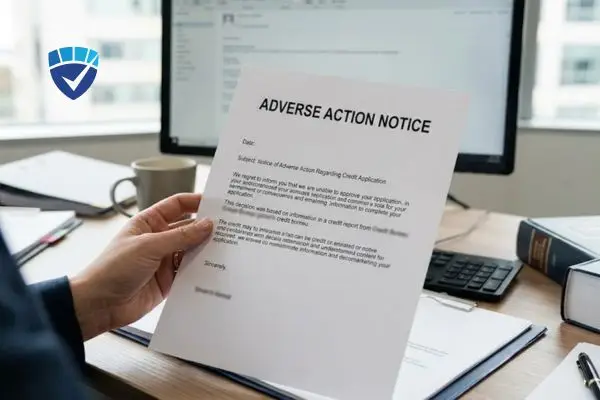
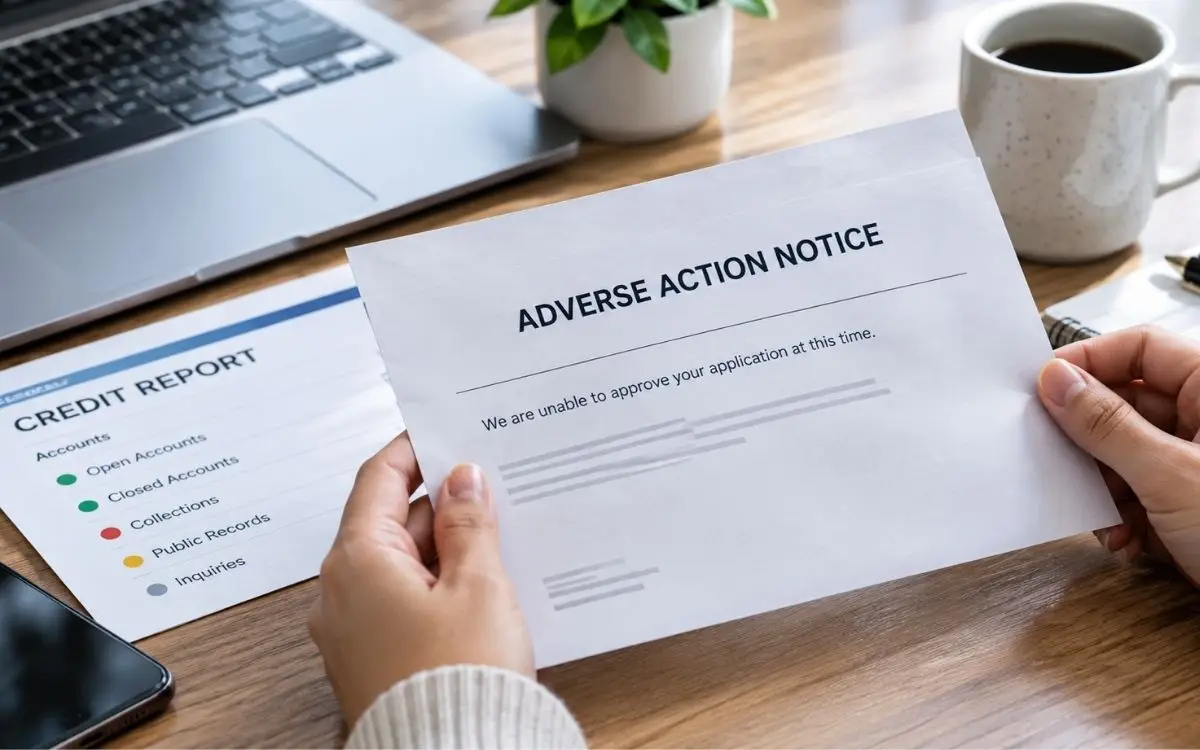
An adverse action notice is a message a business must give you when it takes a negative step against you based, in whole or in part, on information in a consumer report.
That includes credit reports, background reports, tenant screening reports, and some insurance reports. “Adverse action” also covers more than a flat denial.
| Decision Area | What Adverse Action Can Look Like | Report Often Used |
|---|---|---|
| Credit and lending | Loan denial, credit card application denial, a lower line of credit than you asked for, worse account terms | Credit report and credit score |
| Employment | Rejected job application, rescinded offer, denied promotion, termination | Employment background report |
| Housing | Rejected rental application, higher deposit | Tenant screening report |
| Insurance | Denial, cancellation, a higher premium, reduced coverage | Credit history or insurance score |
The Federal Laws Behind Adverse Action Notices
Two federal laws usually come into play.
The Fair Credit Reporting Act (FCRA) controls how consumer reports are collected, shared, and used. It requires an adverse action notice whenever a report influences a negative decision.
The Equal Credit Opportunity Act (ECOA), carried out through a rule called Regulation B, applies to credit decisions. It requires lenders to explain why they denied your application, whether or not a report was involved.
| FCRA Notice | ECOA / Regulation B Notice | |
|---|---|---|
| Who sends it | Any business that used a consumer report (lenders, employers, landlords, insurers) | Creditors |
| When it applies | A report played a role in the decision | Any adverse action on a credit application |
| Main focus | Where the information came from and your right to check it | Why the creditor said no |
| Timing | Not a set number of days in the statute | Generally within 30 days of a completed application |
| Form | Oral, written, or electronic (credit score details must be written or electronic) | Written, with limited exceptions for small creditors |
Many lenders combine both notices into one letter. That’s why your adverse action letter may list both reasons for the denial and credit bureau contact details.
What an FCRA Adverse Action Notice Must Include
Compare your letter against what federal law requires.
- Notice of the adverse action. The business must tell you it took action against you.
- Credit score information, if a score was used. This includes the numerical score and related details, such as the range of possible scores and the key factors that hurt your score.
- The consumer reporting agency’s contact information. You should see the name, address, and phone number of the company that supplied the report. Nationwide credit reporting agencies must include a toll-free number.
- A statement that the agency did not make the decision. The notice must make clear that the reporting company supplied the information but did not decide your application.
- Your right to a free copy of your report. You can request it from that agency within 60 days.
- Your right to dispute. You can challenge inaccurate or incomplete information directly with the agency.
Adverse Action Notices in Credit and Lending

Credit decisions produce the most adverse action notices. You may receive one after a credit card denial, a denied mortgage, or an auto loan denial.
A credit card issuer or bank might also approve you but offer a higher interest rate or worse terms because of your credit history. In that case, you may receive a risk-based pricing notice instead. It tells you your terms were less favorable because of information in your report.
Look closely at the credit factors listed in the notice. Reasons like “too many delinquent accounts” or “serious late payments” mean nothing if those accounts don’t belong to you.
That’s often how people discover credit report errors, a mixed credit file, or accounts opened through identity theft.
Adverse Action in Employment Background Checks
Employers who use a background check company must follow a specific set of steps under the FCRA. These rules apply to pre-employment screening and to decisions about current employees.
Step 1: Disclosure and Authorization
Before ordering a report, the employer must tell you in writing that it may use a background report. This disclosure must be a stand-alone document, not buried in a job application. The employer also needs your written permission.
Step 2: Pre-Adverse Action Notice
Before the employer makes a final decision based on the report, it must send you a pre-adverse action notice. This notice must include a copy of the report and a written summary of your FCRA rights.
The statute doesn’t set a specific waiting period. The FTC explains that this step gives you a chance to review the report and tell the employer if something is wrong. Many employers wait about five business days, but practices vary.
Step 3: Final Adverse Action Notice
If the employer goes forward with the decision, it must send a final adverse action notice. It includes the reporting company’s contact information, a statement that the company did not make the decision, and your rights to a free report and to dispute errors.
| Stage | What the Employer Must Do | What You Should Do |
|---|---|---|
| Before the check | Give a stand-alone disclosure and get your written permission | Read what you sign and keep a copy |
| Before the decision | Send a pre-adverse action notice, a copy of the report, and a summary of rights | Review the report right away and flag errors in writing |
| After the decision | Send a final adverse action notice | Request your free report and dispute inaccurate information |
Some trucking and transportation jobs follow a modified process when the applicant applied only by mail, phone, or online. State law and local rules may also add extra requirements for employers, especially around criminal history. Those rules vary, so an attorney can tell you what applies to your situation.
Common Employment Background Report Errors
Many background check errors start with sloppy matching or outdated records. Watch for:
- Criminal convictions that belong to someone with a similar name
- Expunged records or sealed cases that should not appear
- A single case listed several times
- Wrong employment history or failed employment verification
- Mixed-up identity verification details, such as the wrong birth date
These mistakes can cost you a job you earned. We handle employment background check cases like these nationwide.
Adverse Action in Tenant Screening and Insurance

Landlords often rely on tenant screening reports that pull eviction records, rental history, criminal history, and credit data. If a landlord rejects you or demands a larger deposit based on that report, you should receive an adverse action notice.
Insurance companies may use your credit history to build an insurance score. A denial, a cancellation, or a higher premium based on that information also counts as adverse action. In both situations, you can get a free copy of the report and dispute anything inaccurate.
What To Do After You Receive an Adverse Action Notice
Acting quickly protects your options.
- Keep the notice. Save the letter, email, or screenshot. Good file documentation matters later.
- Request your free report. Contact the agency named in the notice within 60 days. You can also get your reports from the three nationwide bureaus through AnnualCreditReport.com.
- Review every line. Check names, addresses, accounts, balances, payment history, and any public or criminal records.
- Dispute errors in writing. Send a clear dispute letter with copies of your proof. In most cases, the agency must complete its reinvestigation within 30 days.
- Respond to a pre-adverse action notice fast. For a job, tell the employer in writing about any errors before the decision becomes final.
- Talk to a consumer lawyer. If the agency won’t correct the error, or the harm already happened, an attorney can review your options.
When an Adverse Action Notice Points to an FCRA Violation
The notice itself is not always the problem. More often, it points to a problem with the report behind it.
| What Happened | Possible FCRA Issue | Who May Be Responsible |
|---|---|---|
| Your report showed accounts or records that aren’t yours | Failure to use reasonable procedures to ensure accuracy | Credit bureau or background check company |
| You disputed an error and nothing changed | Failure to conduct a reasonable reinvestigation | Credit bureau or the company that supplied the data |
| An employer rejected you without sending the report first | Skipped pre-adverse action steps | Employer |
| Someone pulled your report without a valid reason | No permissible purpose | The business that pulled the report |
One important point: courts in the Seventh Circuit (which covers Illinois, Indiana, and Wisconsin) have held that consumers generally cannot sue a business just for failing to send a proper FCRA adverse action notice. Federal agencies enforce that rule instead.
The report errors behind the denial are a different story. Inaccurate reporting, failed disputes, and background check violations can support an FCRA lawsuit against the companies responsible.
What You May Be Able To Recover
What you may recover depends on the facts of your case and whether the violation was willful or negligent.
| Type of Violation | What the Law Allows |
|---|---|
| Negligent | Actual damages, plus court costs and reasonable attorney’s fees |
| Willful | Actual damages or statutory damages of $100 to $1,000, possible punitive damages, plus court costs and reasonable attorney’s fees |
Actual damages can include lost wages, higher interest costs, and emotional distress, depending on the case. Deadlines apply, too. You generally must file within two years of discovering the violation, and no later than five years after it happened.
How Fair Credit Attorneys Can Help

We are a consumer protection law firm based in Palos Heights, Illinois, and we represent people across the country. We sue companies that violated your credit rights.
When you contact us, an attorney will:
- Review your adverse action notice and consumer reports
- Identify which companies may have broken the law
- Explain your options, from disputes to litigation
- Take your case to court when a company refuses to do the right thing
We only get paid if we win, so you pay nothing out of pocket. Prior results do not guarantee a similar outcome.
Take the Next Step After a Denial
An adverse action notice is more than bad news. It’s a roadmap to the report that shaped the decision and to the rights you have to challenge it.
If that report was wrong, you deserve a fair shot at the loan, the job, or the home you applied for.
Talk with an FCRA lawyer at Fair Credit Attorneys about what happened. Call (866) 381-6444 or schedule your free case review online to find out whether you have a case.
Frequently Asked Questions
Yes. People use the terms interchangeably. Some businesses send the notice as a letter, while others send it by email or share it verbally.
A pre-adverse action notice comes first, only in employment cases. It gives you a copy of the background report and a chance to point out errors. The final adverse action notice comes after the employer makes its decision.
No. The notice itself does not appear on your credit report or change your credit score. The credit inquiry and the information in your report are what matter.
Keep any records you have of the denial and request your reports anyway. A missing notice may be reported to federal regulators. If the denial came from errors in your report, you may still have a claim against the reporting company.