On This Page
You pull your credit report and find accounts you never opened, or a name and address that are not yours. Your first thought is probably identity theft, but sometimes a credit bureau has simply mixed your credit file with someone else’s.
Both problems can cost you a loan, an apartment, or a job, but they need different fixes. Knowing which one you face helps you protect your legal rights under the Fair Credit Reporting Act (FCRA), the federal law that governs credit reports.
Seeing accounts that are not yours? Call Fair Credit Attorneys at (866) 381-6444 or request a free case review. There is no upfront cost to find out where you stand.
What Is a Mixed Credit File?
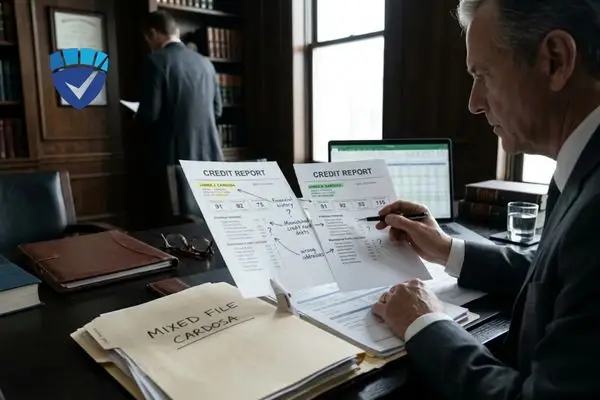
A mixed credit file happens when a credit bureau combines your information with another person’s. The other person’s accounts, debts, and payment history end up on your credit report. Some people call this a merged file.
No one stole anything. The error comes from how credit reporting agencies match incoming data to consumer files.
How Mixed Files Happen
The three major bureaus (Equifax, Experian, and TransUnion) receive data from thousands of lenders, collection companies, and other data sources. Their software decides which file each piece of data belongs to. When that matching is too loose, data lands in the wrong file.
Common triggers include:
- Similar or identical names
- Social Security numbers that differ by one or two digits
- Family members with the same name, such as a Jr. and Sr.
- Shared or similar address history
- Data entry errors by a lender or other furnisher (a company that reports information to the bureaus)
The FCRA requires every consumer reporting agency to follow reasonable procedures to assure the maximum possible accuracy of the consumer reports it prepares. When a bureau mixes two people together, that duty is often where a legal claim starts.
What Is Identity Theft on a Credit Report?
Identity theft happens when someone uses your personal identifying information without permission. That might be your name, Social Security number, or date of birth. The thief uses it to open credit cards, take out loans, or run up debt in your name.
Unlike a mixed file, identity theft starts with a crime. The fraudulent accounts carry your real information, so the credit bureau may see nothing wrong. The damage shows up later as missed payments, collection notices, and fraudulent inquiries.
Mixed File vs. Identity Theft at a Glance
| Mixed File | Identity Theft | |
|---|---|---|
| What happened | A bureau put someone else’s data in your file | Someone used your identity to open accounts |
| Who caused it | Usually the credit bureau’s matching process, sometimes a furnisher’s data entry errors | A criminal, though bureaus and furnishers can make it worse |
| Is there a crime? | No | Yes |
| Whose information is on the accounts | Often another real person’s name, address, or birth date | Your own name and Social Security number |
| Typical first step | Dispute the mixed information with each bureau | Report the theft, place a fraud alert or freeze, and request a block |
| Main FCRA focus | Accuracy procedures and the dispute process | Blocking fraudulent information and the dispute process |
Warning Signs: How to Tell Which One You Are Dealing With
Read your full credit history from all three bureaus. Then compare what you see against the clues below. These are patterns, not rules, and some reports show both problems at once.
| What You See on Your Report | Often Points To |
|---|---|
| A name, nickname, or AKA you have never used | Mixed file |
| Addresses you never lived at, often near where a similar-named person lives | Mixed file |
| A wrong date of birth or a Social Security number variation | Mixed file |
| Old accounts with years of payment history you know nothing about | Mixed file |
| New accounts opened recently that you never applied for | Identity theft |
| Hard inquiries from a credit card application or loan you never started | Identity theft |
| Bills, password resets, or account alerts you did not request | Identity theft |
| Collection notices for debts you never took on | Either one |
A useful test: ask whose personal information is attached to the strange accounts. If it is someone else’s, a mixed file is likely. If it is yours, identity theft is more likely.
Why the Difference Matters
Getting the diagnosis right shapes everything that comes next.
Different Fixes
A mixed file needs the bureau to separate your data from another person’s. You start by disputing the inaccurate information and asking the bureau to remove everything that does not belong to you.
Identity theft calls for extra protective steps. The FCRA lets you request that a bureau block information that resulted from identity theft. To do that, you send proof of your identity, an identity theft report, a list of the fraudulent items, and a statement that the transactions were not yours. The FTC’s IdentityTheft.gov can help you create that report.
Different Legal Claims
In a mixed file case, the focus is often on whether the bureau followed reasonable procedures and whether it properly reinvestigated your dispute.
In an identity theft case, the focus is often on what happened after you reported the fraud. Did the bureau block the accounts? Did the lenders and collection companies investigate when the bureau notified them, or did they keep reporting fraudulent accounts?
Treat a mixed file like identity theft, or the other way around, and you may file the wrong paperwork. The real problem can stay on your report for months.
Your Rights Under the Fair Credit Reporting Act
Whichever problem you have, the FCRA gives you real tools. You have the right to:
- Get free copies of your credit reports and review them for errors
- Dispute inaccurate information with each credit bureau
- Have the bureau conduct a reasonable reinvestigation within the reinvestigation period the law sets
- Have inaccurate or unverifiable information deleted or corrected
- Place a free fraud alert or security freeze if you suspect identity theft
- Request a block of information that resulted from identity theft
- Take legal action if a bureau or furnisher breaks the law
If you win an FCRA case, a court may award financial compensation. That can include actual damages for things like loan denials, higher interest rates, lost employment opportunities, and emotional distress. If the violation was willful, statutory damages and punitive damages may also be available. The court can also order the company that broke the law to pay your attorney fees. Every case is different, so the outcome depends on the facts. You can learn more about what you can recover in an FCRA lawsuit in our guide.
What to Do Next
If you see accounts that do not belong to you, take these steps:
- Pull all three reports. Errors often appear on one bureau’s report but not the others.
- Save every document. Keep denial letters, adverse action notices, collection notices, and bills for accounts you never opened.
- Decide which problem you have. Use the warning signs table above as your guide.
- File your disputes in writing. A clear dispute letter with supporting documents creates a record of what you sent and when.
- Add protection if it is identity theft. Report the theft at IdentityTheft.gov, then place a fraud alert or security freeze.
- Keep monitoring your credit. Mixed information and fraudulent accounts can come back after a dispute. Credit monitoring helps you catch it early.
- Talk to an attorney if the error stays. If a bureau verifies wrong information or ignores your evidence, your rights may have been violated.
When to Talk to an FCRA Attorney
Many people dispute an error two or three times and get the same form response. That is often the point where legal help makes the biggest difference.
Consider getting legal guidance if:
- The bureau “verified” accounts that are clearly not yours
- The same mixed or fraudulent information came back after removal
- You were denied credit, housing, or a job because of the error
- The problem has caused financial hardship or stress in your daily life
An experienced FCRA attorney can review your reports, your dispute history, and your denial letters. We hold credit bureaus, lenders, and collection companies accountable when they fail to follow the law.
Get Help Separating Your Credit From Someone Else’s Mistakes

Whether a credit bureau mixed your file with a stranger’s or a thief used your name, you did not cause this. The law puts the duty of accuracy on the companies that report your credit, and you have the right to hold them to it.
Fair Credit Attorneys sues credit bureaus and furnishers that violate the FCRA. Call (866) 381-6444 or contact our team to schedule a free consultation. We work on contingency, so you pay nothing out of pocket, and we only get paid if we win your case.
Frequently Asked Questions
Yes. The difference is whose information is attached. A mixed file often shows another person’s name or address, while identity theft uses yours.
Often, yes. The FCRA requires bureaus to follow reasonable procedures to assure maximum possible accuracy, and a mixed file can signal those procedures failed.
A fraud alert will not fix a mixed file. If you are unsure which problem you have, a free alert or security freeze adds protection while you sort it out.
You may be able to if the bureau failed to follow reasonable procedures, reinvestigate your dispute, or block fraudulent information. An attorney can review your facts.